By 11am on a Georgia July morning, you have already lost. The driveway is radiating, the garage feels like a kiln, and the ambient temperature outside is doing something that should be illegal. The question is not whether your house is air-conditioned. Everybody's house is air-conditioned. The question is whether your house is actually designed to feel cool, or just mechanically not-hot. There is a meaningful gap between those two things, and it shows up the first time you walk into a room that is 72 degrees but still somehow feels like a waiting room.
Some rooms make you exhale. The temperature drops out of your head and you just feel the relief of it. Most rooms do not do that, even at the same thermostat setting. The difference is design: specific decisions about light, color, material, air movement, and visual temperature that either amplify your HVAC or fight against it. Here is what that actually looks like in practice.
Window Treatments: The Wall That Actually Does Work
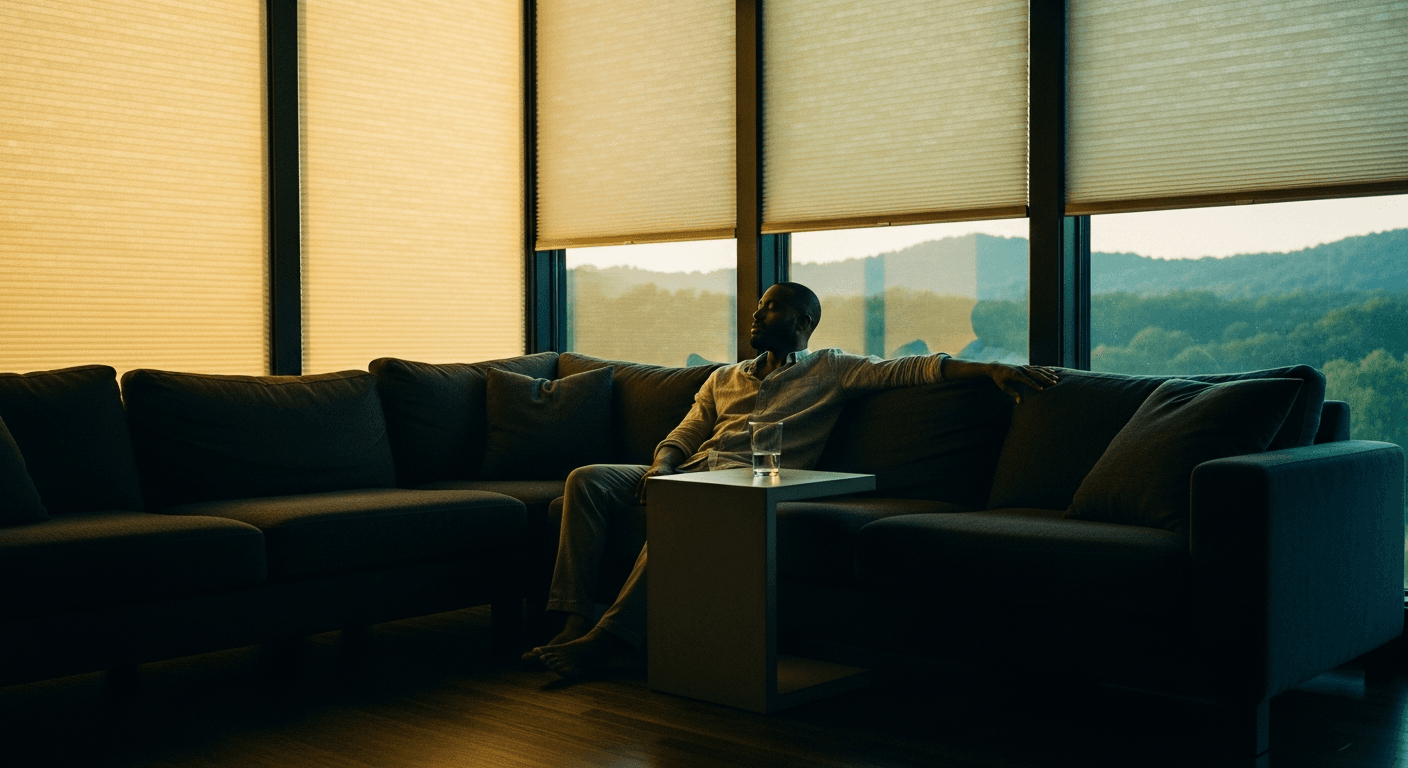
The single most impactful thing you can do to a Georgia room in July costs less than a new sofa and takes an afternoon to install. Cellular shades (specifically honeycomb cellular shades in a light-blocking or room-darkening fabric) are the correct answer for any window that takes direct sun between 9am and 4pm. Not sheer linen panels. Not plantation shutters alone. Not blinds you half-close and forget about. Cellular shades.
Here is why, from a building-science angle: glass transmits radiant heat regardless of what the air temperature says. A single-pane window in direct sun is essentially a space heater you installed in your wall. A double-pane low-E window is meaningfully better but still leaks radiant load. A cellular shade creates a dead-air buffer between the glass surface and the room: the same principle as insulation in a wall cavity. The honeycomb cell traps air; trapped air does not convect heat into your living room.

The secondary benefit is that a room with controlled light reads as cool even before your nervous system registers the temperature. This is not psychology-trick nonsense. It is the same reason a shaded porch at 88 degrees feels more comfortable than a sunny porch at 80. Light carries thermal signal. Dim the room, the body reads 'refuge.'
For rooms that face east or west, consider layering: cellular shade for the heat work, a linen or cotton drapery panel for the softness and the blackout capability at night. Roman shades in a heavy cotton are a fine middle ground. What you are trying to avoid is anything that looks cool but does nothing: sheer panels, cheap bamboo roll-ups, or plantation shutters that let sun pour through the louvers all day while looking like they are doing something.
Ceiling Fans: The Truth Nobody Tells You
Ceiling fans do not cool the air. Say it again until it sticks. A ceiling fan running in a room with no one in it is doing exactly nothing useful for the temperature. What ceiling fans do is create a wind-chill effect on skin: the moving air accelerates moisture evaporation and drops your perceived temperature by 4 to 8 degrees depending on humidity and air speed. That is significant. But only when you are in the room. Only when the fan is rotating the correct direction. And only when it is sized right for the space.
Most ceiling fans in Georgia homes are too small, running the wrong direction, and mounted too high to matter.
The correct summer direction is counterclockwise when viewed from below. This pushes air straight down. Clockwise is the winter setting that pulls air up and redistributes warm air from the ceiling. Most fans have a small direction switch on the motor housing. Most homeowners have never touched it.

Sizing: a room under 200 square feet, 42-inch fan minimum. A 12x16 living room wants 52 inches. Anything bigger than a 20-foot great room should have two fans or one 60-plus-inch statement fan: the kind that moves enough air you can feel it from the couch. The brands doing this well right now are Big Ass Fans (yes, that is actually the brand name, and they are genuinely the best), Haiku by Big Ass Fans for the smart-home crowd, and Monte Carlo for the design-conscious rooms where you want something that earns its place on the ceiling aesthetically.
One more thing: slow fan speeds in humid Georgia summers often do more than high speeds. High speed on a humid day moves warm wet air over you faster, which can feel worse. Set it to medium, close the door, and let the room work.
The Dark-Cool Den: A Design Goal Worth Having
If you have never been in a properly designed dark room on a 97-degree Georgia afternoon, you do not know what you are missing. I am talking about a room with dark walls (deep charcoal, forest green, navy, oxblood), minimal natural light, heavy window treatment, low-slung furniture, and the specific atmosphere that makes you want to pour something over ice and not leave until dinner.
This is not a design trend. This is a design response to climate. Southern houses have been building shaded, deep-set rooms for as long as there have been Southern houses: the keeping room off the back of a plantation house, the gentlemen's study with its south-facing bookcase wall blocking afternoon sun. The logic is thermal: dark surfaces absorb heat rather than reflecting it into the room's air column, and a room that limits solar gain through thoughtful treatment of its surfaces and openings is a room that your HVAC can actually hold at 70 degrees without cycling every 12 minutes.
The design goal is simple: one room in the house that functions as the summer anchor. Where the TV is. Where the bar cart is. Where the good reading chair lives. Where you sit at 3pm when the thermometer outside says something obscene and you have nowhere to be.

For Atlanta houses specifically: if you have a bonus room over the garage, a basement walk-out, or a study that faces north, you already have the bones. The north-facing room is naturally the coolest room in the house from May through September. It is also frequently the room that gets ignored in design because it does not have the dramatic natural light that draws attention. That is the room to lean into. Dark it down. Furnish it for staying. Make it the room where summer actually becomes livable.
The Iced-Everything Bar Setup
A summer bar is not the same object as a winter bar. This is a design distinction most people do not make, and it shows in the setup.
A winter bar is amber and warmth: bourbon decanters, a whiskey stone or two, glasses that hold heat. A summer bar is cold theater. The visual cues matter: a large-format ice bucket or countertop ice maker that produces clear cubes, a set of double-walled rocks glasses that sweat without warming the drink, tongs instead of a scoop, a dedicated rail for the tall-glass cocktails that become the language of a Georgia summer.
The countertop clear-ice machines have dropped significantly in price over the last two years. The Opal 2.0 by GE Profile makes the good nugget ice that every cocktail bar uses: the soft, compacted ice that absorbs the drink and keeps it cold without diluting it fast. The Luma Comfort makes clear block-style cubes that look serious in a rocks glass. Either of these on a bar cart or countertop signals that someone in this house takes the ritual seriously.
The ritual is the point. July in Georgia is uncomfortable enough that the moments of relief (a cold drink in a cool room at the end of a day that hit 96 by 2pm) carry actual weight. The house that is designed to deliver those moments is doing something real.
Set the bar up for it. The room will do the rest.
Tell me what room you are working with (dimensions, which direction it faces, what the current window situation looks like), and I will tell you exactly what moves to make first.
Thinking about a move?
Beckett Real Estate works the whole of Metro Atlanta. Tell me the address or the neighborhood and I will tell you what the house is really like, what the inspection usually finds, and what the number should be.
See homes for saleTalk to an agent nowMore articles like this