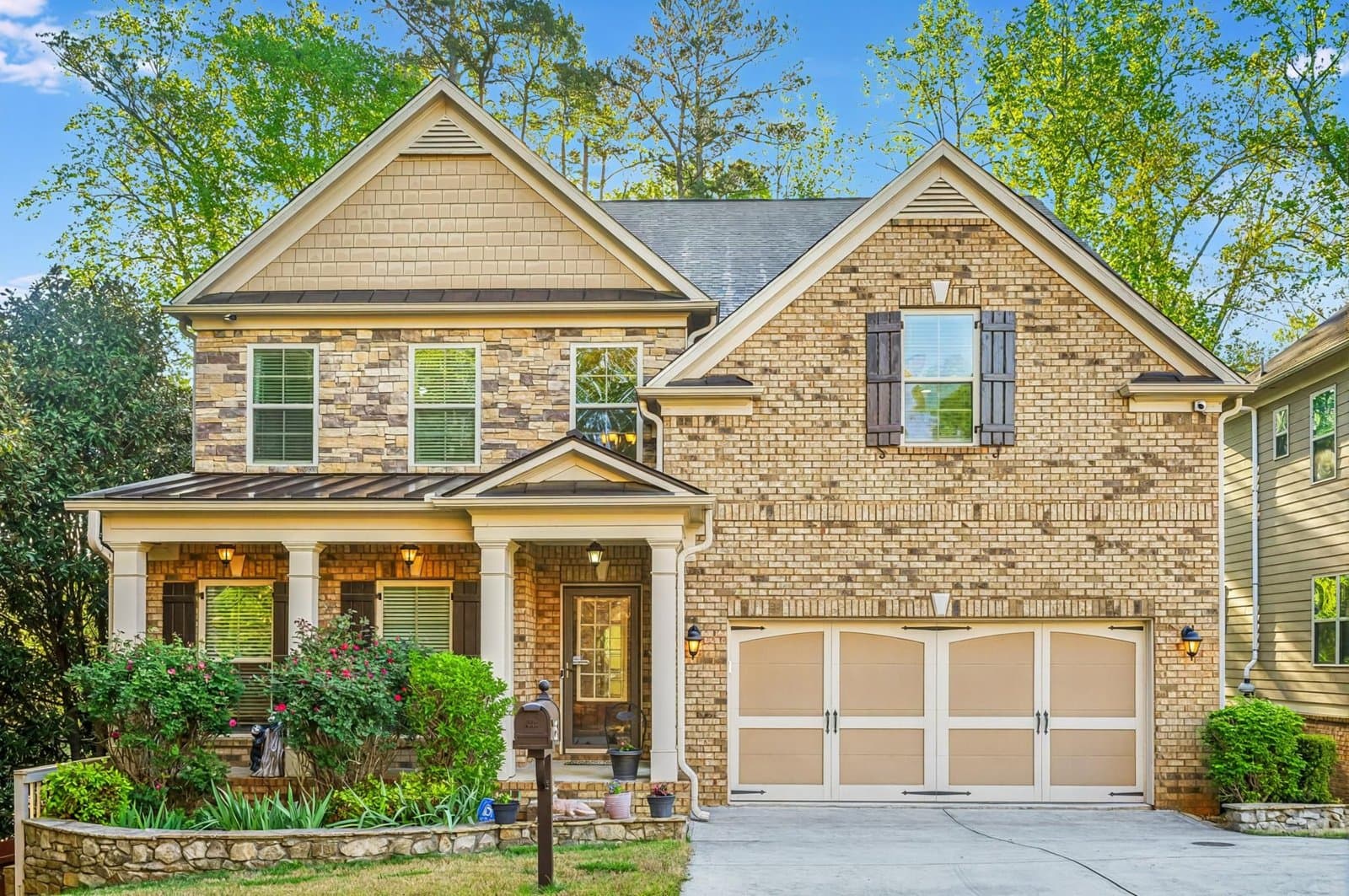

Metro Atlanta has forty-one towns worth taking seriously and no single best one. Here is how the suburbs actually differ on price, commute, schools and what you give up, using live listing data rather than a top-ten list somebody wrote in 2019.
The Honest Version of This List
Most "best Atlanta suburbs" articles are a ranking. This one is not, because a ranking answers a question nobody actually has. Nobody is choosing between Alpharetta and Newnan. They are choosing between two or three places that fit a budget, a commute and a school situation, and the useful thing is knowing what separates them.
So this is a map, not a leaderboard. I have grouped Metro Atlanta the way buyers actually experience it — by corridor — and for each one I have said what it costs, who it suits, and what you are trading away. That last part matters most and it is the part these lists always leave out.
What the Current Market Actually Looks Like
As of 28 August 2026 I am tracking 1,132 active listings across 41 Metro Atlanta cities. That is the dataset behind the price figures on this page. It leans toward the upper half of each market, so read the numbers as "what the better inventory costs" rather than as a full-market median.
Listing figures come from active FMLS listings I track, as of 28 August 2026. They skew toward the upper end of each market rather than representing a full-market median, and inventory moves weekly. Verify current pricing and availability before you act on any number here.
Two things stand out this month. New construction is a much bigger share of the good inventory in the north than in the south — in Alpharetta, 37 of 45 tracked homes were built in 2020 or later, and the median build year is 2026. In Newnan the median build year is 2015 and in Marietta it is 2022, but Marietta's range runs back to 1915. You are not choosing between old and new. You are choosing which mix you want to shop in.
North Fulton: Alpharetta, Milton, Johns Creek, Roswell
This is the corridor people mean when they say they want "the good schools and the short commute to the office park." GA 400 is the spine, Avalon and downtown Alpharetta are the anchors, and the tech and finance employers along Windward and Old Milton keep demand steady even when rates move.
What it costs: in Alpharetta the homes I track run $1,780,000 to $9,250,000, with a median of $3,599,999. That is the top tier of that market, and the entry-level picture is very different — but it tells you what the ceiling looks like, and the ceiling in North Fulton is genuinely high.
What you give up: land, mostly, and quiet. Lot sizes shrink as you move toward the GA 400 corridor, and traffic on Windward Parkway at 5pm is its own weather system. You also pay a premium that is partly school reputation and partly proximity to employers — if you work from home full time, you may be buying something you will not use.
Best for: buyers who want new construction, want walkable town centers, and either work in the North Fulton employment corridor or value the schools enough to pay for them.
Cobb: Marietta, Smyrna, Kennesaw, Acworth
Cobb is the most internally varied county in the metro, and Marietta is the clearest example. The homes I track there run $1,750,000 to $5,750,000 with a median of $2,190,000, and the build years range from 1915 to 2026. There is no single Marietta housing stock. There is a historic core around the Square, mid-century neighborhoods, and new infill — often within a couple of miles of each other.
That variety is the reason Marietta is the most-searched town in this whole cluster, and it is also why generic advice about it is useless. A 1950s ranch off Roswell Road and a 2024 build in East Cobb are different purchases with different inspection risks and different resale stories.
What you give up: consistency. Cobb rewards buyers who do their homework street by street, and punishes buyers who assume a ZIP code guarantees anything.
Best for: buyers who want intown access without intown prices, and who are willing to shop specific neighborhoods rather than a whole city.
South Metro: Peachtree City, Fayetteville, Newnan, Senoia
The south side is where the metro's value still lives, and the numbers make that plain. In Newnan the homes I track run $469,000 to $2,280,000, median $684,450. In Fayetteville, $446,500 to $4,590,000, median $839,000. In Peachtree City, $600,000 to $6,995,000, median $794,495. Those are entire price tiers below North Fulton for houses that are frequently newer and almost always larger per dollar.
Peachtree City is the outlier of the group and deserves its own sentence: roughly a hundred miles of golf cart paths, which sounds like a novelty until you watch a fourteen-year-old drive themselves to practice. It changes how a family runs.
What you give up: the commute, if you have one. From Newnan or Fayetteville to Midtown is a real drive, and I-85 north in the morning is not a road you can plan a career around. The airport, on the other hand, is close — which is why this corridor is full of people who fly for work.
Best for: space per dollar, families who want a yard, frequent flyers, and anyone whose commute is either nonexistent or southbound.
Forsyth and North Gwinnett: Cumming, Suwanee, Buford
This is the corridor buyers move to when North Fulton prices them out but they want the same school-district conversation. Suwanee and Buford both hold real inventory in the tracked set, and Lake Lanier is close enough to matter for weekends.
One market signal worth knowing: the advertising cost on Buford search terms is extraordinarily high — several times the metro norm. That is a reliable sign that a lot of businesses are competing for people moving there, which usually means demand is rising faster than the listings admit.
Best for: buyers who want newer construction and strong schools at a discount to North Fulton, and who do not need to be intown often.
Cherokee: Woodstock, Canton
Woodstock's downtown did what a lot of suburbs tried to do and failed at — it became a place people drive to on a Friday night. Canton is earlier in that curve and prices reflect it. Both put you well north of the perimeter, which is fine until you need to be inside it twice a week.
Best for: buyers who want a real downtown and are comfortable being genuinely north.
Intown: Decatur, Smyrna, Sandy Springs, Brookhaven
Intown and near-intown is where you stop buying square footage and start buying minutes. Decatur in particular searches like a suburb but lives like a small city, and its inventory is thin enough that good houses do not sit.
Best for: buyers who will actually use the walkability, and who would rather have a smaller house in a place they can walk out of.
How to Actually Choose
Three questions decide this for almost everyone, in this order:
1. Where do you physically have to be, and how often? Not where your employer is registered — where you have to put your body. Twice a week to Midtown is a different answer from twice a month.
2. What is the school situation in the next six years, not now? People buy for the elementary school and then spend a decade in the high school.
3. What are you willing to have go wrong? Older housing stock trades a lower price for a longer list of systems that will need attention. That is a legitimate trade, but make it on purpose.
Frequently Asked Questions
What is the best suburb of Atlanta?
There is not one, and any article that names one is guessing at your commute. North Fulton wins on new construction and employer proximity. The south metro wins on space per dollar and airport access. Cobb wins on variety and intown access. The right answer is the one that matches where you actually have to be.
What are the safest suburbs of Atlanta?
Crime statistics vary enormously street to street inside a single city, so a city-level ranking is close to meaningless for a buyer. Look at the specific neighborhood, check the county sheriff's and local police department's published data for the current year, and walk it on a weeknight.
Which Atlanta suburbs have the best schools?
North Fulton and Forsyth County consistently draw buyers on school reputation, and Cobb has several very strong clusters. Because ratings and attendance zones both change, check the current year's state report card and confirm the zone for the specific address rather than the city.
Where should I live in Atlanta if I work downtown?
Look intown or near-intown first — Decatur, Smyrna, Sandy Springs, Brookhaven — and treat any northern suburb as a two-days-a-week proposition at most. The GA 400 and I-75 corridors are manageable off-peak and punishing at peak.
Which Atlanta suburbs give you the most house for the money?
The south metro, clearly. Median tracked prices in Newnan and Peachtree City sit in the $680,000 to $795,000 range against $3.6 million in Alpharetta, and the southern homes are frequently newer.
The Bottom Line
Metro Atlanta does not have a best suburb. It has about a dozen good answers to different questions, and the expensive mistake is choosing on reputation instead of on the three questions above. If you tell me where you have to be and what you are trying to protect, I can narrow forty-one towns to two in about ten minutes.
Want the Version That Applies to You?
Every number above describes a market. None of them describes your budget, your commute, or the school your kid actually needs. If you are weighing one of these towns against another, send me the address or the neighborhood and I will tell you what I would tell a client: what the houses are really like, what the inspection usually finds, and what the number should be.
Get in touch with Beckett Real Estate, or browse what is on the market right now.
Thinking about a move?
Beckett Real Estate works the whole of Metro Atlanta. Tell me the address or the neighborhood and I will tell you what the house is really like, what the inspection usually finds, and what the number should be.
See homes for saleTalk to an agent nowMore articles like this