The last thing you want to do during the final week of a World Cup is walk into the wrong bar at the wrong time and spend ninety minutes standing three deep behind someone wearing a face-painted flag you don't recognize, holding a warm domestic lager, unable to see the second half.
The right move is simpler than that. And it starts by thinking in districts, not destinations.
Pick a Neighborhood, Then Wander Into It
Midtown and West Midtown are the two neighborhoods that make the most sense for match days right now. Not because they have the 'official' watch parties or the biggest screens — that's not the point. It's because both neighborhoods give you what a long match-day afternoon actually needs: density, walkability, multiple fallback options, and the kind of outdoor seating that makes a ninety-minute match feel like a proper afternoon instead of an errand.
Midtown runs along Peachtree from about 10th Street up through Piedmont Park's edge, and the corridor has enough patios, beer halls, and neighborhood bars that you can walk in at noon and still be making good decisions at eight. The energy right now is every jersey on earth — you'll be sitting next to someone from Senegal, someone from Colombia, someone from Ohio in a Mexico kit who can't fully explain why. That mix is the point. It's the only two weeks every four years where Atlanta actually looks and sounds like the city it's becoming.
West Midtown — the stretch around Howell Mill and up through the Westside Provisions District — is the quieter call for people who want to watch seriously without the frat-house volume. The patios are bigger, the crowds skew slightly older, and the food situation is considerably better if you're settling in for a long session.
The Structure of a Match-Day Afternoon Done Right
Here's how the day actually works when you do it well.
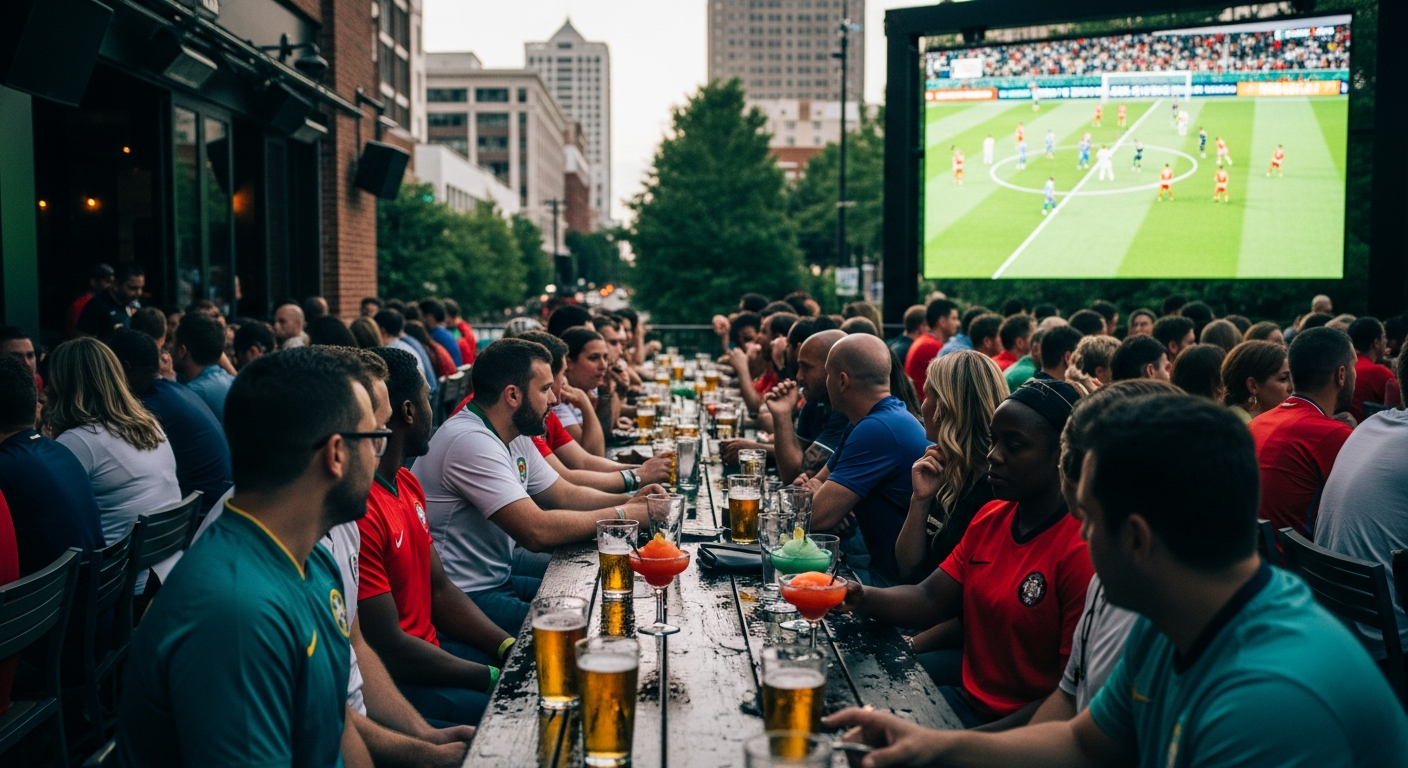
The opening match — wherever it kicks off — is best watched somewhere with enough crowd energy to make early goals feel like events. A beer hall format works. Long communal tables, loud when it matters, enough ambient noise that the commercial breaks don't feel like waiting in line. You're not there for the food. You're there for the communal television experience, which is genuinely one of the better ones in sports.
By the time halftime hits, you've identified whether your current spot has enough gas in the tank for the second half, or whether it's time to move. This is the thing most people don't plan for: the graceful exit. If the crowd is wrong for the match, or the sightlines are bad, or someone three tables over has decided this is the appropriate moment to do a drum circle — you leave. That's why you picked a walkable district instead of a single venue. There's always another patio within four minutes of where you're standing.
The second match of the day — if there is one — is where the afternoon really opens up. This is when you want a rooftop. The timing usually lands right around that window between four and seven o'clock when Atlanta's summer heat starts to break at altitude and the golden hour comes in from the west. A rooftop patio at five-thirty during a World Cup knockout match with the Atlanta skyline behind you and the city buzzing below is a specific kind of good that's hard to manufacture outside of a two-week window every four years.
Plan for that second act. It's the one people forget.
---
The BeltLine Factor
If you're in Midtown, the BeltLine is the connective tissue that makes the whole strategy work. The Eastside Trail runs along the edge of the match-day district and the energy during tournament weeks spills onto the trail in both directions — people walking between bars, kids in jerseys, someone with a portable speaker carrying a match audio feed.
Use the BeltLine as your transit between acts. Walk fifteen minutes north or south depending on where you want to end up, and you've reset the energy, cleared your head, and arrived at the next spot without the full effort of finding parking twice. It's also the move that separates someone who actually lives in Atlanta from someone who drove in from the suburbs and is now circling the same two blocks looking for a spot.
For West Midtown, the logic is the same without the trail infrastructure — you're working the Howell Mill corridor on foot, which is shorter but denser. The walk between venues is three to five minutes instead of fifteen. Different energy, same principle.
How to Choose Your Spot When You Arrive
A few criteria that hold across every neighborhood and every match:
First, check the sightline before you sit. Walk in, look at where the screens are, figure out whether you'll be watching straight-on or at a forty-five-degree neck angle for ninety minutes. Walk out if the answer is the latter. There is always another option.
Second, look at who's already there. A mix of neutrals and die-hards is good. A room full of neutrals who are really there for the bottomless brunch and happen to have soccer on is bad. A room full of passionate die-hards for the specific match you're watching is the best possible scenario and worth whatever the sightline compromise is.
Third, order early. Kitchens during tournament week are running at a pace that doesn't account for the halftime rush. Get food in during the first fifteen minutes of a match, not at the whistle. The people who order at halftime are the ones eating cold food during a penalty shootout.
Fourth, have the exit ready. Know the next spot before you need it. Check the map. Give yourself the option.
---
The Final Week Is Different
The knockout stage of a World Cup plays differently than the group stage did. The early weeks had a lot of matches, which meant a lot of bars running a lot of screens showing different games, and the crowd was split across allegiances. The final week concentrates everything. Fewer matches, higher stakes, bigger rooms, louder reactions.
The Midtown and West Midtown match-day experience right now — this specific week — has a particular charge to it that Atlanta gets maybe once in a generation when it hosts. The city is genuinely a part of this tournament in a way it hasn't been before, and the neighborhoods show it. There are flags hanging from windows on streets that have never had flags hanging from windows. There are people at the corner table having a conversation in a language you don't speak, watching the same ninety minutes you're watching, feeling the same tension at the same moment.
That's worth planning a proper afternoon around. Don't just wander in and find a stool. Set it up right.
Pick your district. Plan the rooftop second act. Know your BeltLine exit. Order before halftime. Go find what the final week of a once-every-four-years tournament actually feels like in a city that earned the right to host it.
Text a friend who'll go all-in on the afternoon — the ones who'll still be there for the second match are the ones you want with you.