
Family Handyman just ran a piece on safety pin hacks. Nine of them. And it's fine: genuinely useful stuff for threading drawstrings and pinning hems.
But the junk drawer isn't where most homeowners are missing their edge. It's in the mechanical room, the attic, the crawlspace. The places they never go, and the places where the real money either stays in their pocket or walks out the door.
Twenty years as a licensed contractor and project manager taught me to ignore the cute stuff and go straight to the systems. Not because I'm a killjoy. Because the systems are where the surprises live.
The Four Tools Actually Worth Knowing About
If you want to feel useful in your own house — and catch the things that cost $4,000 to $18,000 when nobody catches them first — here's what deserves a spot somewhere more accessible than the junk drawer.
1. A $15 non-contact voltage tester
This is the one I hand every buyer who's serious about a property before we even write an offer. Looks like a fat pen. You hold it near an outlet, a switch, or a junction box (no contact required) and it tells you whether the circuit is live. Doesn't require an electrician. Doesn't require pulling covers.
Why it matters in metro Atlanta specifically: a huge percentage of the pre-1985 housing stock in Clayton, Henry, DeKalb, and south Fulton was wired during the aluminum-wiring era or had amateur add-ons in the 80s and 90s that never got permitted. A non-contact tester doesn't diagnose that fully, but it flags dead circuits, reversed wiring, and hot-when-it-shouldn't-be boxes in about 10 seconds. That's information before you're under contract, not after.
2. A $12 outlet tester with GFCI check
Plug it in. Three lights. The pattern tells you whether the outlet is wired correctly: open ground, open neutral, reversed polarity, open hot. Takes four seconds per outlet.
In the houses I walked as a project manager (particularly kitchen and bath gut-renovations in Smyrna, Marietta, and Douglasville), I found reversed-polarity outlets on permitted work more times than I care to admit. The inspector signed off. The outlet tester wouldn't have. Know how to use one.

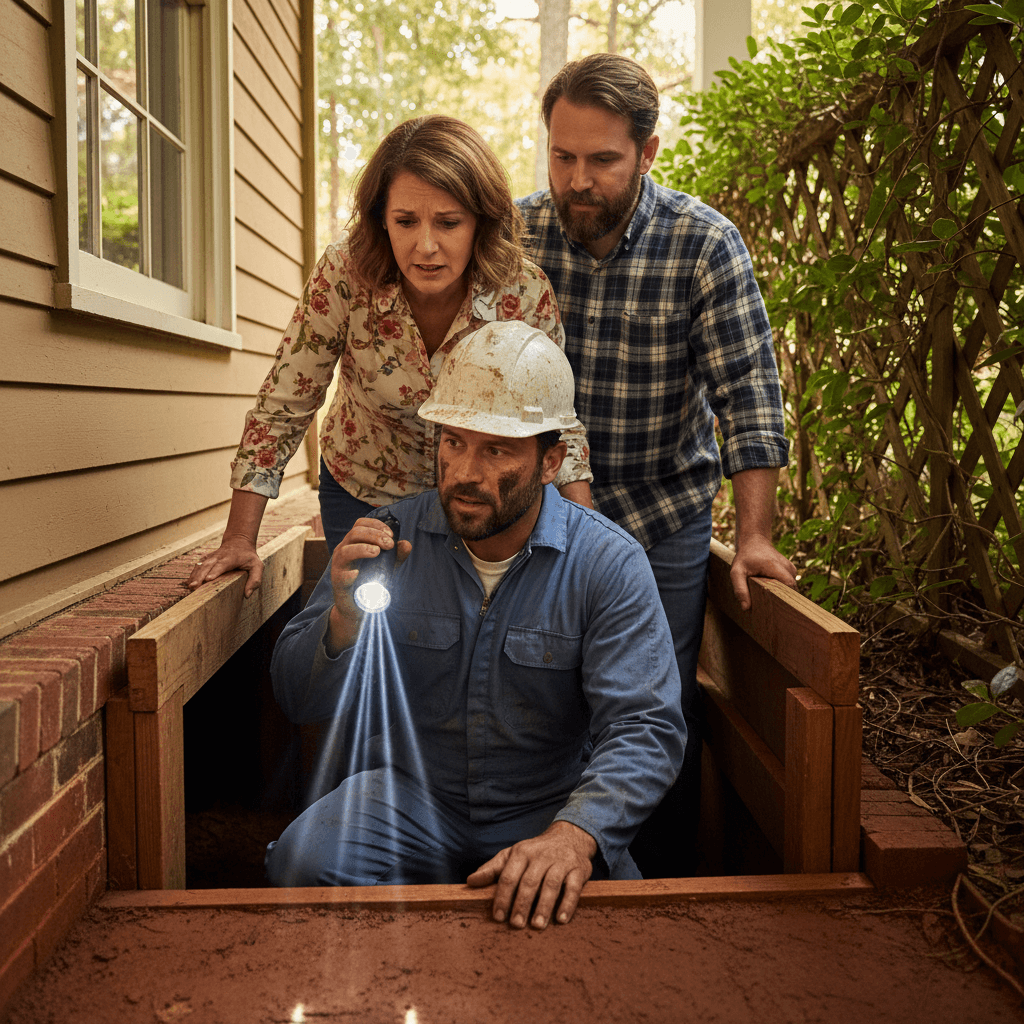
3. A flashlight with a 90-degree head (not your phone)
Your phone flashlight is for finding your keys. A headlamp or 90-degree LED light is for reading a rim joist, looking at the bottom chord of a roof truss, or checking whether the flex duct in the attic has separated at the boot. The angle matters. You need both hands. You need to be able to hold a position for 45 seconds while your eyes adjust to what you're actually looking at.
I've crawled attics in Stockbridge, Jonesboro, and Fayetteville where the flex duct had partially disconnected at the AHU: meaning the HVAC was conditioning the attic, not the house. Every system was 'passing' on the thermostat. The homeowner had no idea. A phone flashlight pointed generally upward would have missed it. A proper light held at the right angle caught it.
4. A cheap infrared thermometer
Not a thermal camera — those are $300+ and overkill for most homeowners. A basic IR thermometer is $20 at any hardware store. Point it at supply registers and return registers while the HVAC is running. You're looking for a 16-to-22 degree differential between supply air temp and return air temp. Significantly outside that range in either direction tells you something: undersized equipment, refrigerant issue, duct leakage, or a dirty coil.
In Coweta and Spalding county homes built in the early 2000s, I've seen systems that were original (20-plus years old) still 'working' in the sense that they produced some cold air. The IR thermometer said 9 degrees of differential. The system was coasting on borrowed time and delivering maybe 60 percent of its designed output. The homeowners had been compensating with higher electric bills and calling it normal.
What This Is Really About
Safety pin hacks are fun. I'm not here to mock a listicle.
But there's a version of homeownership, and a version of buying a house, where you walk in with actual diagnostic tools and the knowledge to use them. And there's a version where you walk in hoping the inspector catches everything and the seller disclosed what they knew.
One of those versions costs more money. Usually a lot more.

The four tools above total somewhere around $60. They don't make you a licensed contractor. They make you a homeowner who can walk their own property and ask the right questions, or a buyer who can identify a problem before it becomes a negotiating ambush or a post-closing repair bill.
Beckett Real Estate brings construction-trained eyes to every walkthrough. Building systems (electrical, plumbing, HVAC, roofing, structure) are where the actual money hides. Most buyers find out after closing. That's the gap worth closing.
Send the address. A construction-informed walk-through is what tells you whether the price reflects the condition or papers over it.
Looking in Smyrna?
Beckett Real Estate works Smyrna end-to-end — active listings, off-market opportunities, and the construction-trained walk-through that tells you what the price reflects vs. what it papers over.
Browse Smyrna listings → · Schedule a tour with Beckett Real Estate
Thinking about a move?
Beckett Real Estate works the whole of Metro Atlanta. Tell me the address or the neighborhood and I will tell you what the house is really like, what the inspection usually finds, and what the number should be.
See homes for saleTalk to an agent nowMore articles like this