There's a specific kind of Saturday morning that every hands-on homeowner knows. The one where you walk outside with coffee, fully intending to do one small thing — trim a branch, check the gutters, maybe finally pressure-wash the back steps — and instead you discover something that rewrites the entire day. Maybe the entire weekend.
Sometimes it's a nest. Sometimes it's standing water where standing water should not be. Sometimes it's a family of raccoons who have decided your soffit vent is an excellent nursery.
That last one? That one requires immediate, undivided attention. No photos. No documentation. Just you, the situation, and the animal control number you didn't know you needed.

What nobody tells you before they buy a house in the Atlanta metro: the building envelope is a negotiation. Your house is constantly being tested by weather, by pressure differentials, by temperature swings that go from 22°F in January to 98°F by July, and by wildlife that is frankly very good at identifying structural weaknesses before you are.
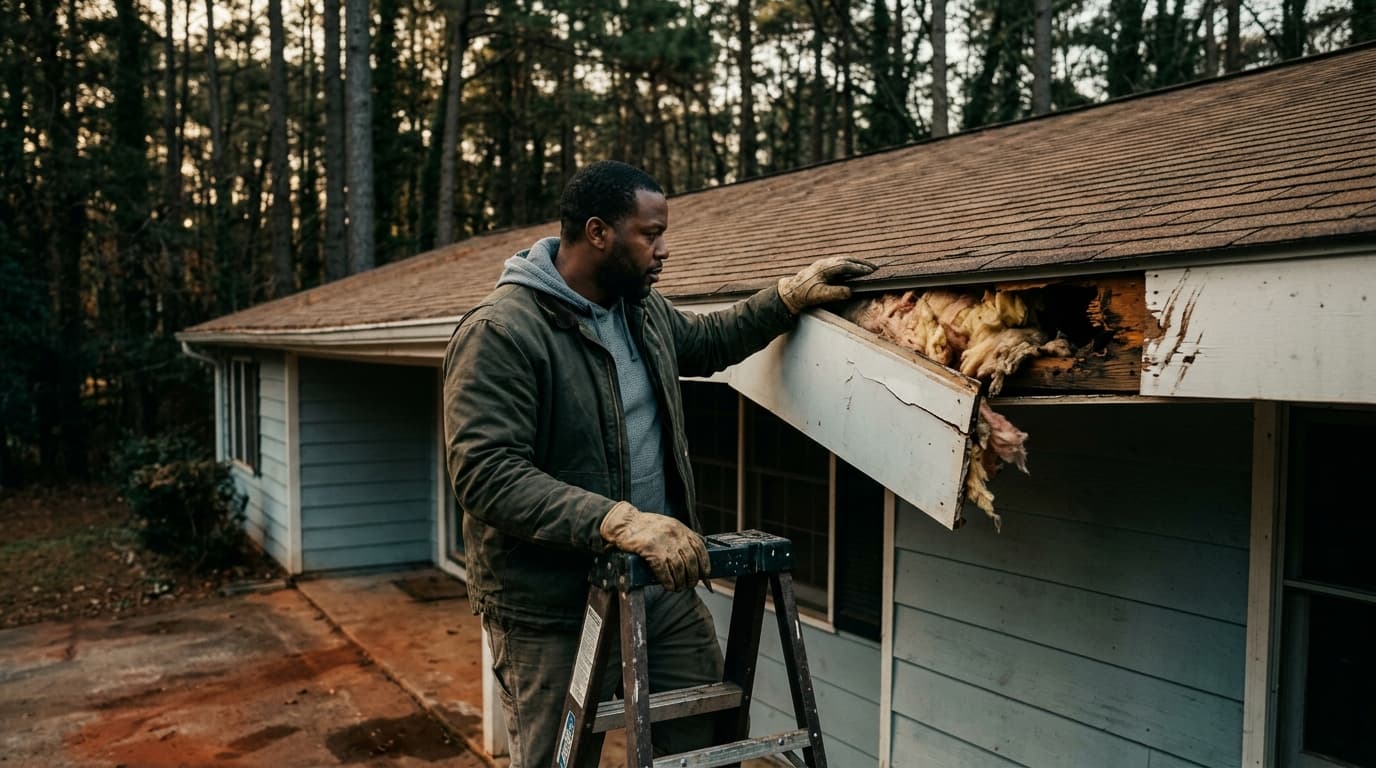
Raccoons don't choose your attic randomly. They find it because something — a loose vent screen, a rotted fascia board, a soffit panel that's been pulling away from the framing for two seasons — gave them a reason to investigate. They're just following the opening that was already there.
What 20 Years in Construction Taught Me About Animal Intrusion
When I was running projects — commercial buildings, data centers, residential homes across metro Atlanta — one of the things that separated a quality build from a problem build was how the envelope transitions were handled. Specifically: every place where a material type changes, where a vent penetrates a surface, where a soffit meets a fascia, where a drip edge meets a shingle. Those transitions are where the building breathes. And if they're not detailed correctly, they're also where everything else gets in.
On residential homes in our market — older ranches in Fayette County, the craftsman builds in Peachtree City, the '90s subdivision stock everywhere from Newnan to Stockbridge to McDonough — the most common failure points are almost always the same:
Soffit vents. The plastic or aluminum mesh corrodes or cracks, the screen pulls away from the housing, and you've got a three-inch gap that a raccoon reads as an invitation and a bat reads as a five-star hotel.
Fascia board rot. In Georgia's humidity cycle, wood fascia that isn't properly primed, painted, and maintained will start showing moisture damage within five to seven years. Once it goes soft, it's not just an aesthetic problem — it's a structural one. Raccoons can push through soft fascia with their hands. I have watched this happen.
Dryer and HVAC exhaust vents. Factory-installed flapper vents on dryer exhausts are notoriously bad at maintaining their seal over time. A lot of older homes in the metro have vents where the flapper is either stuck open or missing entirely. Squirrels. Always squirrels.

The fix for all three of these is cheap. The fix after wildlife has been in your attic for one or two breeding seasons is not cheap. I have seen attic insulation in homes around Henry County that had to be completely removed and replaced because of what a raccoon family does to blown-in insulation over a summer. That's a $4,000 to $9,000 project, depending on square footage and access. The new soffit vent screen that would have prevented it is about $8 at Home Depot.
The Saturday Morning Walk-Around You Should Actually Be Doing
Most homeowners think of inspection as something that happens when you buy the house. One time, one document, filed away, done.
That's not how buildings work.
A building envelope inspection is something you should be doing — informally, with your own eyes — at least twice a year. Spring and fall. Here in Georgia, spring is especially important because we've just come through a winter where temperature differentials were doing real work on caulk joints, paint film, and any wood that was already compromised.
What I actually look at when I do a walk-around on my own property:
Roofline. From the ground, with binoculars if you need them. Any lifted shingles, missing shingles, or granule loss visible on the lower courses. Any daylight showing around the ridge cap. Gutters pulling away from the fascia — that's a fascia rot indicator, not just a gutter problem.
Soffit and fascia. Walk the entire perimeter. Look for any place where the soffit panel is no longer flush with the fascia, any paint peeling on the fascia, any visible screen damage on the vents. If you can see daylight through a vent from outside, something can see daylight from inside.
Foundation vents. Crawlspace homes in our market — and there are a lot of them, especially in the older southside stock — have foundation vents that are every bit as vulnerable as soffit vents. Screen them properly. Check them annually.
Where pipes and wires penetrate the exterior. Every place a gas line, electrical conduit, HVAC line set, or plumbing vent comes through the exterior wall or roof is a potential entry point. Look for daylight. Look for missing caulk. Look for staining that suggests something has been going in and out.
This walk-around takes about 20 minutes. It costs nothing. It is the difference between a Saturday morning coffee observation and a Sunday afternoon emergency wildlife removal call.

The point isn't to be paranoid. The point is to read the building before the building starts sending you invoices.
I've walked properties in Senoia, in Tyrone, in Stockbridge, in McDonough where the inspection report came back clean and the homeowner still had a wildlife problem within six months of closing. Not because the inspector missed it — because the damage was at a stage where it wasn't yet visible without knowing where to look. The screen was there. It was just barely there. One good thunderstorm, one motivated raccoon, and 'barely there' becomes 'wide open.'
That's the difference between buying a house with a general inspection and buying a house with someone who spent twenty years actually installing and verifying these systems. The experience changes what your eyes are trained to find.
Start the walk-around. Every spring. Every fall. Coffee in hand is fine — it's the right pace for this.
Send the address if you want a second set of eyes. Beckett Real Estate looks at these systems first.
Thinking about a move?
Beckett Real Estate works the whole of Metro Atlanta. Tell me the address or the neighborhood and I will tell you what the house is really like, what the inspection usually finds, and what the number should be.
See homes for saleTalk to an agent nowMore articles like this