
There is a project in Xunpu, a coastal fishing village on China's Fujian coast, that has been making the rounds in architecture circles. Super Jinjiang, a flagship experience store built for a footwear and apparel conglomerate, sits inside a neighborhood of historic Minnan houses, oyster-shell walls, and a 600-year-old hairpin flower tradition. The architects did not flatten the context. They read it, then responded to it.
I am not writing about Chinese retail design because it is exotic. I am writing about it because it illustrates a principle that almost every spec builder in metro Atlanta ignores completely, and that principle shows up in the bones of every house I have walked in 20 years of construction work.

The Principle: Architecture Answers the Site, or It Doesn't Answer at All
The Xunpu project is built in a place with a specific material language. Oyster shells mortared into wall panels. Carved granite lintels. Pitched red-tile rooflines reading against a harbor sky. The designers did not pretend those things don't exist. They used them: not as decoration bolted onto a generic box, but as a structural logic that organizes how you move through the building, how light enters, how the inside and outside talk to each other.
That is what context-responsive architecture actually means. Not a regional motif printed on the lobby wallpaper. The building's geometry, materiality, and sectional organization are in conversation with the place it occupies.
Now look at what gets built in Peachtree City, Newnan, Woodstock, and Alpharetta. Same footprint. Same plan. Rotated 90 degrees and dropped on a different lot. The architecture is not in conversation with anything: not the topography, not the climate, not the street, not the neighboring buildings. It is a floor plan in search of a zip code.
What 'Context' Actually Looks Like in a Georgia Build
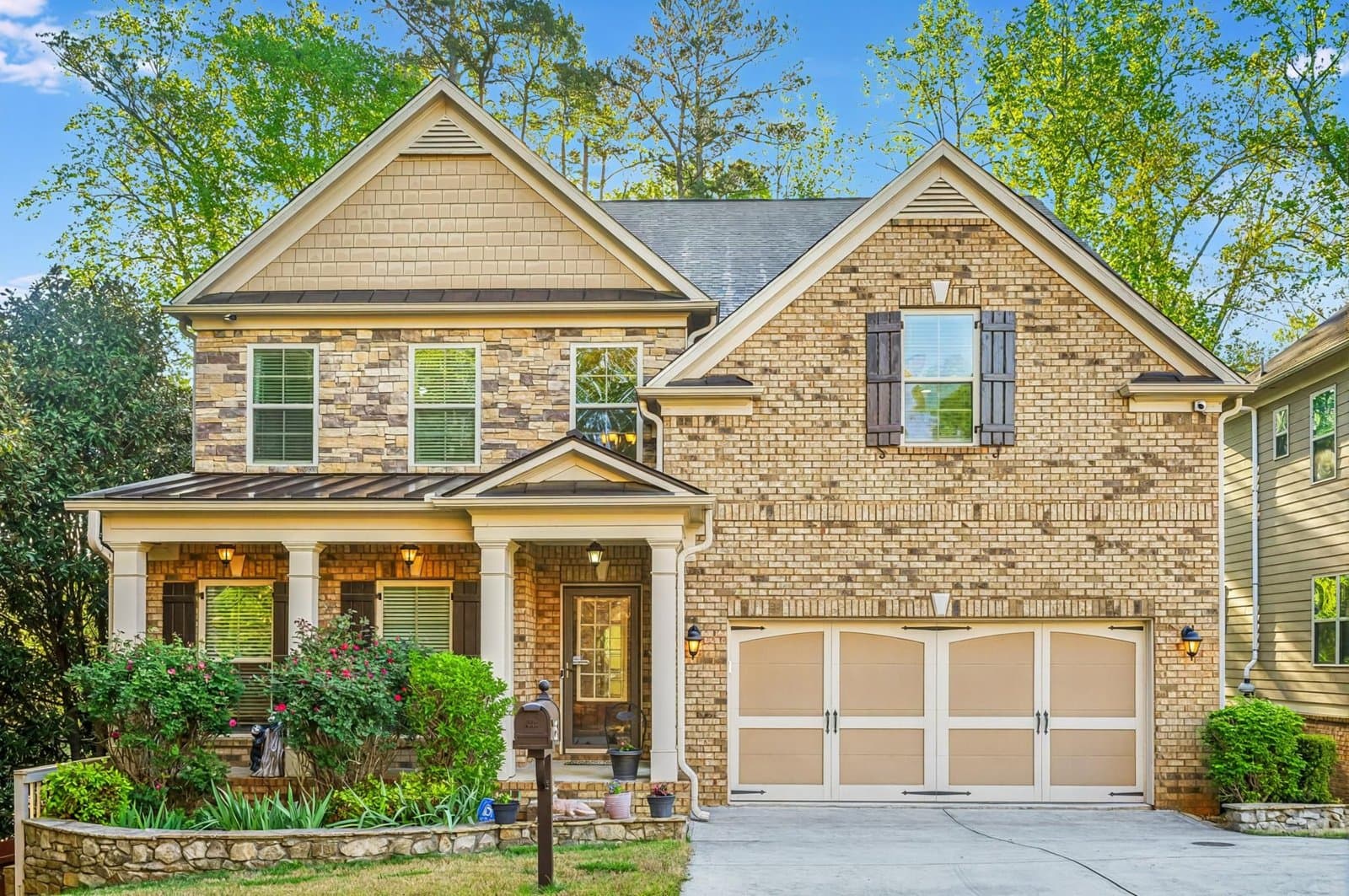
Atlanta and its surrounding counties have a genuine material vernacular if you look for it. Brick: not the thin veneer face-brick that gets glued onto OSB sheathing, but full-depth modular brick in the Flemish bond patterns that show up on older homes in Decatur, Druid Hills, and the Brookhaven neighborhoods east of Peachtree Road. Board-and-batten siding in the coastal counties. Stone from the North Georgia quarries: Elberton granite, Cherokee County fieldstone. Heart pine floors salvaged from old tobacco warehouses in Griffin and LaGrange.
These are not nostalgia moves. They are a regional material intelligence that has been largely abandoned in favor of what is cheapest to procure at scale from national lumber yards and big-box suppliers.

The Super Jinjiang designers made one decision that I think is the most instructive: they did not try to make the old and the new look the same. The historic Minnan houses read as historic. The contemporary insertions read as contemporary. The intelligence is in the relationship between them: the gap, the contrast, the way one makes you see the other more clearly.
That is the move that most Atlanta builders cannot execute, because it requires actual architectural thinking rather than a floor-plan library and a production schedule.
What This Means for the House You Are Buying or Building
If you are renovating in a neighborhood with architectural character — Grant Park, Kirkwood, Inman Park, any of the older Fayette County communities like Tyrone or Senoia — the question is not 'how do I match the old part.' The question is 'how do I let the old part and the new part make each other legible.'
In practice, that means a few specific things:
Keep the material hierarchy honest. If the original house is brick, the addition does not have to be brick. But the addition's material needs to be chosen in direct response to the brick, not in ignorance of it. A zinc panel addition next to a 1928 Craftsman bungalow can work. Hardiplank painted to approximate brick never does.
Respect the sectional logic of the original structure. Old Southern houses were built with high ceilings, deep overhangs, and cross-ventilation in mind. When you add to them, the addition's ceiling height and fenestration should acknowledge why the original was designed the way it was, not override it with whatever the framing package defaults to.
The transition joint is the design. Where the old building meets the new one is the moment of maximum architectural responsibility. In the Xunpu project, those transitions are handled with precision: a narrow light slot, a change in floor material, a shift in ceiling plane. In most Atlanta renovations, the transition is drywall butted against original plaster and caulked. That is not a design decision. That is avoidance.

The Construction Reality Underneath the Design Conversation
I spent 20 years running electrical, plumbing, framing, HVAC, and roofing across commercial and residential builds — and then shifted into the project manager and foreman role, which meant my job was to make sure what the architect drew was what the subcontractors actually built. I have read a lot of plans. I have also watched a lot of plans get value-engineered into something the architect would not recognize.
The Xunpu project is notable partly because the architects appear to have maintained enough control over execution that the built product matches the design intent. That is not a given. It is the result of a client who understood what they were buying, a design team with enough authority to hold the line on critical decisions, and a construction process rigorous enough to deliver on the geometry.
In the Atlanta market, on most residential builds, that chain of custody breaks down somewhere between the design development drawings and the framing inspection. A detail that requires a custom-fabricated bracket gets substituted with a standard clip. A window rough opening gets shifted two inches because the framing crew was working off a different sheet. The cumulative effect of those decisions is a building that looks approximately like the design intent and performs nothing like it.
When I walk a property now, whether it is a resale in McDonough or a new construction in Milton, I am reprising the same quality-gate role I held on commercial projects. I am reading the building for evidence of where the design intent held and where it got traded away. That evidence is almost always visible. You just have to know what you are looking at.
The lesson from Xunpu is not that your next Atlanta home needs to look Chinese. The lesson is that the best buildings, anywhere, are built by people who took the place seriously enough to let it shape the response. That discipline is rare. When you find a house that has it, you are holding something most buyers walk past without seeing.
Send me the address. A construction-trained walk-through is what tells you whether the design intent made it into the walls, or got caulked over somewhere along the way.
Thinking about a move?
Beckett Real Estate works the whole of Metro Atlanta. Tell me the address or the neighborhood and I will tell you what the house is really like, what the inspection usually finds, and what the number should be.
Explore new constructionSearch homes for saleTalk to an agent nowMore articles like this