
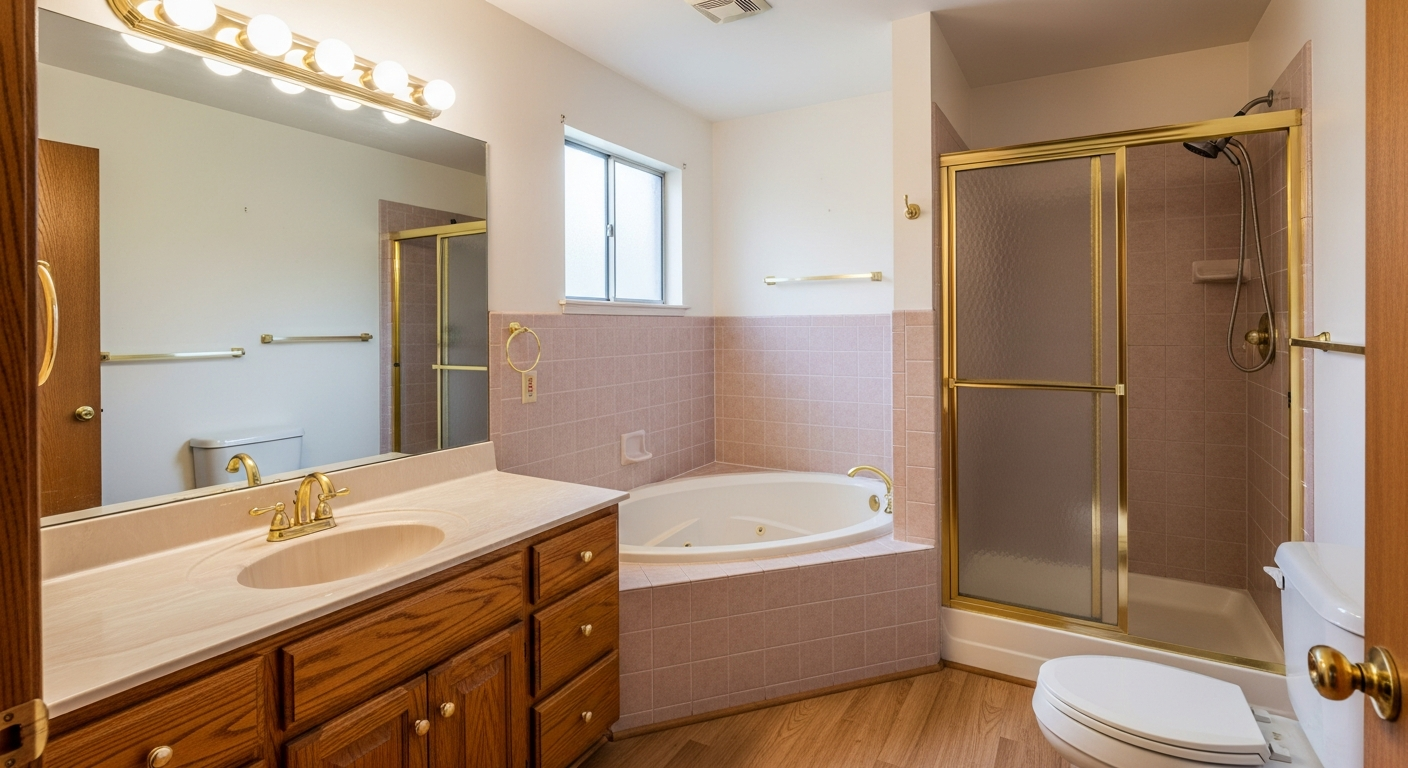
What we're working with: the 1990s brass-fixture bathroom
The 1990s suburban Atlanta bathroom follows a script: 60-inch oak vanity with cultured-marble integral sink in bone or almond, brass faucet with separate hot/cold handles, 6×6 ceramic tile on walls in almond or mauve, matching 12×12 floor tile, garden tub with brass trim and a brass-framed shower door, and a four-bulb Hollywood light bar in polished brass. The toilet is bone, the exhaust fan cover is yellowed plastic, and there's a builder-mirror glued directly to drywall. Every finish screams 1994.
From a construction-eye view, most of the bones are fine. The rough plumbing is copper or CPVC behind the walls, drain lines are cast iron or ABS in the slab, and the layout is rational — vanity on one wall, tub-shower combo opposite, toilet tucked in the corner. The exhaust vent is 4-inch rigid ducting to the roof, not flex hose stapled to soffit. The subfloor is solid — either 3/4-inch T&G plywood over joists or slab-on-grade with no deflection. What kills buyer interest is purely cosmetic: the brass, the almond tile, the cultured marble that can't be separated from the vanity, and the oak cabinet doors with their arched cathedral panel and fake-antique pull knobs.
The trap in these bathrooms is over-renovating. Buyers in the $350K–$475K range — the core Fayette/Coweta market in 2026 — don't expect spa-grade Carrara and a freestanding Kohler tub. They want clean, neutral, and move-in ready. Ripping out functional tile and replumbing a working shower is budget arson. The goal is a cosmetic refresh that erases the decade markers and adds the visual cues — beadboard, polished nickel, white paint, warm subway tile — that signal 'Traditional Southern' without the $40K gut job.
Style direction: Traditional Southern
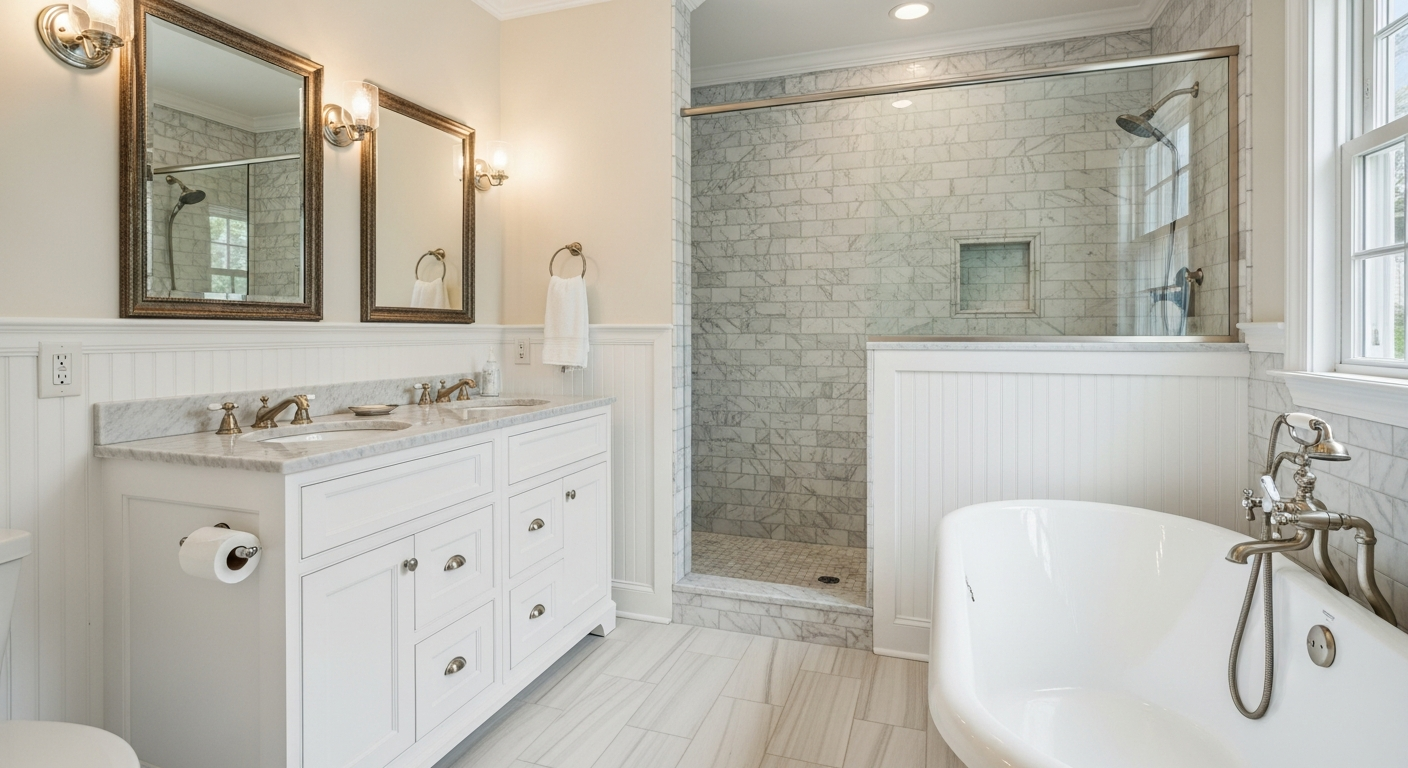
Traditional Southern in a bathroom means inset-panel cabinetry painted in a soft white or linen, polished-nickel hardware and plumbing fixtures, honed or polished marble countertops, beadboard wainscoting to chair-rail height, large-format subway tile in showers with pencil-rail trim, wide-plank tile or luxury vinyl in warm white or light oak tones, framed mirrors in aged brass or nickel, and clear-glass sconces flanking the vanity. The palette is whites, creams, soft grays, and warm neutrals — no stark whites or cold grays that read modern farmhouse or Scandinavian. The look is rooted in Charleston single-house parlors, Savannah row-house powder rooms, and the restrained classicism of Southern Living editorial from 2008–2015.
For the 1990s bathroom, that translates to a 60-inch double-vanity with Shaker-style inset doors painted in Decorator's White, polished-nickel cup pulls, a honed Carrara marble or white quartz top with undermount sinks, polished-nickel widespread faucets, beadboard wainscoting to 36 inches with a chair rail in the same white, a reglazed tub and shower surround in bright white, new polished-nickel tub spout and shower trim, large-format 3×12 marble subway tile as a vertical accent strip in the shower with pencil-rail border, luxury vinyl plank flooring in a wide white-oak pattern, two framed mirrors in brushed nickel, and a pair of clear-glass sconces with nickel backplates on either side of each mirror. The effect is cleaned-up heritage, not Instagram coastal, and it photographs well for MLS.
Cost breakdown — Atlanta MSA, mid-2026
| Line Item | Cost |
|---|---|
| New vanity (in-stock 60-inch with cultured-marble or quartz top) | $1,800 |
| New faucets, toilet, and trim (towel bars, hooks, mirror) | $1,400 |
| Reglaze existing tub + shower surround (professional service) | $900 |
| New shower doors (semi-frameless, replace brass frame) | $1,500 |
| Paint over existing tile with epoxy bath paint (DIY-friendly) | $200 |
| New flooring — luxury vinyl plank over existing vinyl | $1,200 |
| Lighting (replace Hollywood bar with two sconces + a vanity light) | $650 |
| Replace mirror with framed model | $280 |
| Paint walls + trim | $450 |
| Plumber day rate + electrician day rate + contingency | $6,120 |
| Total | $14,500 |
Beckett Real Estate's construction-eye notes
What to KEEP: the rough plumbing if the shut-off valves don't weep and the drain lines run clear — no reason to open walls and disturb cast-iron stacks or CPVC risers that function. The existing exhaust vent if it's 4-inch rigid ducting with a roof cap, not undersized flex hose. The double-gang electrical box behind the Hollywood light bar can be reused for two sconces with a junction splice in the attic. The tub itself if the enamel is intact and the apron isn't cracked — reglazing costs $900 versus $2,200 to demo, haul, and set a new alcove tub, and a reglazed surface lasts 7–10 years with proper care. The drywall and studs are sound; there's no mold, no soft spots, no reason to gut to the framing.
What to GUT: the cultured-marble vanity top — it's a single molded piece with integral sinks, and you cannot retrofit undermount bowls or swap the faucet spread without destroying it. The oak vanity cabinet is particle-board with a thin veneer; paint won't hold, and the hinge plates strip out within two years. The 6×6 wall tile has to go if you're doing a true remodel, but for a $14,500 cosmetic job, high-adhesion epoxy bath paint (Rust-Oleum Tub & Tile, Homax, or similar two-part formulas) can cover almond tile in white for under $200 in materials — it's a 72-hour DIY project, not a gut. The vinyl flooring is original and likely contains asbestos in the backing; if the surface is intact, lay luxury vinyl plank directly over it with a vapor barrier. The brass shower door frame and the garden tub faucet trim must go — they're the loudest decade markers in the room.
What's the TRAP: skipping the moisture barrier behind any new tile in wet areas. Modern code — IBC 2021 and IRC 2021, adopted by Georgia in 2023 — requires a waterproof membrane (Schluter Kerdi, RedGard liquid, or equivalent) behind all shower tile, and inspectors in Fayette, Coweta, and Henry counties check for the red or orange membrane edge at the pan. If the existing 6×6 tile was set with mastic on green board, there's no membrane, but if the plan is epoxy paint rather than retile, it's not an issue. The second trap is choosing 12×24 or larger tile on walls that aren't perfectly flat — every stud crown, every drywall seam telegraphs through large-format tile, and the lippage is visible under sconce lighting. Stick with 3×12 subway or 4×4 if the walls aren't shimmed. The third trap is setting a freestanding tub on framing designed for a fiberglass alcove unit — the floor joists and subfloor weren't engineered for the point loads of a cast-iron or stone-resin tub, and the flex will crack grout and strain drain connections within six months.
One process note: reglaze the tub and tile BEFORE painting walls or installing the new vanity. The reglaze process involves acidic etching, aerosol primer, and two-part epoxy topcoats with volatile solvents — it's a 48-hour cure, and overspray will ruin fresh drywall paint and new cabinet finishes. Mask off everything, ventilate with a box fan in the window, and schedule the reglaze as day one of the project. The new vanity, faucets, lighting, and flooring go in after the reglaze has cured and the room has aired out.
Home value impact
Remodeling Magazine's 2024 Cost vs. Value report for the Atlanta MSA pegs a midrange bathroom remodel at 67% cost recapture at sale. A $14,500 cosmetic refresh should add roughly $9,700 in appraised value, assuming the rest of the house is in similar condition. The bigger win is qualifying for the next buyer tier: homes with updated baths sell 18–24 days faster in Fayette and Coweta markets, and buyers pre-approved at $375K will stretch to $385K if the bathroom doesn't require immediate work. The brass-fixture bathroom is a silent deal-killer — buyers see it, mentally deduct $15K–$20K, and submit lowball offers or walk. A $14,500 investment erases that penalty, resets the buyer's mental math, and moves the listing from 'needs work' to 'move-in ready' in the MLS narrative.
For an honest opinion and a realistic evaluation, contact Beckett Real Estate. Call Evan now: 866-578-8917 or schedule a free consultation.
Thinking about a move?
Beckett Real Estate works the whole of Metro Atlanta. Tell me the address or the neighborhood and I will tell you what the house is really like, what the inspection usually finds, and what the number should be.
Estimate your renovation costSearch homes for saleTalk to an agent nowMore articles like this