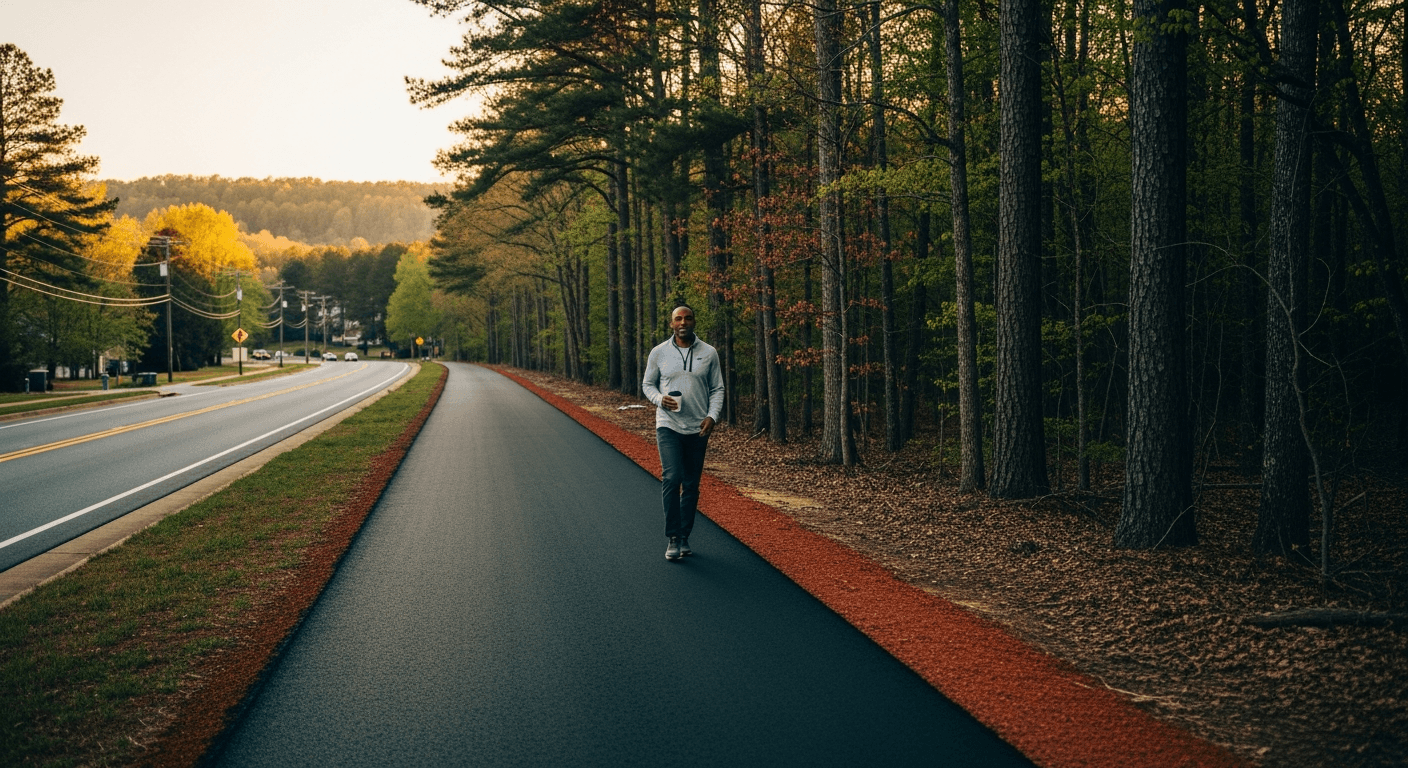
The City of Roswell wrapped construction this week on the Hardscrabble Road Multi-Use Trail: $2.5 million in public infrastructure, 3,000 linear feet of 8-to-10-foot-wide trail along Hardscrabble Road, and another 1,200 linear feet along King Road. Ribbon-cutting is Thursday. Mayor Robichaux and the full civic contingent will be there.
Most people will read this as a parks story. A walkability upgrade. A nice thing for Roswell High School kids.
That is not how I read it.

What Trail Infrastructure Actually Signals in a Real Estate Market
Here is the pattern I have watched play out across metro Atlanta for twenty years: you do not get trail investment without a neighborhood that has already crossed a threshold. Cities do not spend $2.5 million connecting schools and parks in corridors they do not believe in. The money follows conviction.
The 'Slow Down in Roswell' initiative is not a one-off project. It is a network build: the explicit goal is linking schools, parks, neighborhoods, and the historic downtown into a connected trail system. That is the tell. When a city starts thinking in networks rather than individual amenities, the underlying asset base is being repositioned. The street-level amenity stack is being upgraded to match a buyer demographic that will pay for it.
The Beltline proved this in intown Atlanta. The Eastside Trail section between Old Fourth Ward and Ponce City Market broke ground as a nice park idea. Within three years, the half-mile radius was the hottest real estate corridor in the city. The Kevin Rouse properties on Irwin, the boutique infill on Sampson, the condo conversions on DeKalb Avenue: the trail was the leading indicator, not the lagging one.
North Fulton is doing the same thing at a different scale and a different price point.
Roswell's Specific Play: Hardscrabble to King Road
The section they just finished is north of downtown Roswell — the Hardscrabble and King Road corridor. That is meaningful geography. This is not a trail connecting two already-gentrified nodes. This is infrastructure extending walkable connectivity into a transitional zone between Roswell's established historic core and the higher-density residential fabric farther out.
For a buyer evaluating North Fulton right now, this is the kind of infrastructure signal that tends to compress the window between 'reasonable price' and 'you missed it.' Roswell has been one of the more consistent performers in Cherokee-adjacent North Fulton: strong schools, genuine historic downtown, less of the homogeneous subdivision feel that dominates Alpharetta's western edges. What it has lacked is the kind of connected walkable infrastructure that younger professional buyers with money now treat as a baseline expectation.
This trail closes that gap. Not completely. Roswell is not Decatur, and it is not trying to be. But a $2.5 million public infrastructure commitment, framed as part of a larger network initiative, is the city saying out loud that it intends to compete for that buyer.

What Twenty Years on Jobsites Teaches You About Reading Public Infrastructure
I spent a long time as a project manager and construction specialist — commercial, residential, transit infrastructure, data centers. Part of that role was quality gate: making sure public and private construction performed as designed once it was handed over. You learn to read what a jurisdiction is willing to spend money on as a signal of institutional confidence.
A $2.5 million multi-use trail is not a cheap project. Eight-to-ten-foot-wide shared-use path with proper base prep, adequate drainage, ADA-compliant transitions at every road crossing, and real grade management on a busy traffic corridor: that is real construction. The low-end bikeway that gets striped on an existing road is a different animal entirely. What Roswell built here is the kind of infrastructure that holds up, integrates into existing systems, and does not become a maintenance headache in five years.
That detail matters because it reflects the quality of the conviction behind the investment. This is not a ribbon-cutting project designed to photograph well and fall apart by 2028. The spec they chose says they built it to last.
Cities that build public infrastructure to last are cities that believe in their trajectory. And in real estate, trajectory is the entire game.
The North Fulton Buyer Right Now
If you are looking at Roswell, Canton, Alpharetta, or the Milton corridor — and you are weighing timing — this kind of infrastructure signal is worth factoring into your read. The buyers who moved intown in 2012 because of what the Beltline was becoming, not what it already was, made the right call. The ones who waited until the trail was finished and the restaurants were open paid a significantly different number.
North Fulton is not intown Atlanta. The price point is different, the density is different, the buyer profile is different. But the underlying logic is the same: public infrastructure investment precedes, not follows, the price inflection.
Roswell just dropped $2.5 million on a trail network north of its historic core. The ribbon-cutting is Thursday. The buyers who clock the signal today are ahead of the ones who read about it in a market report next spring.
Send me the neighborhood you are watching in North Fulton. Beckett Real Estate tracks the infrastructure pipeline alongside the listing data, because the infrastructure tells you where the listing data is going.
Thinking about a move in Roswell?
Beckett Real Estate works the whole of Metro Atlanta. Tell me the address or the neighborhood and I will tell you what the house is really like, what the inspection usually finds, and what the number should be.
See homes for sale in RoswellAbout RoswellTalk to an agent nowMore articles like this